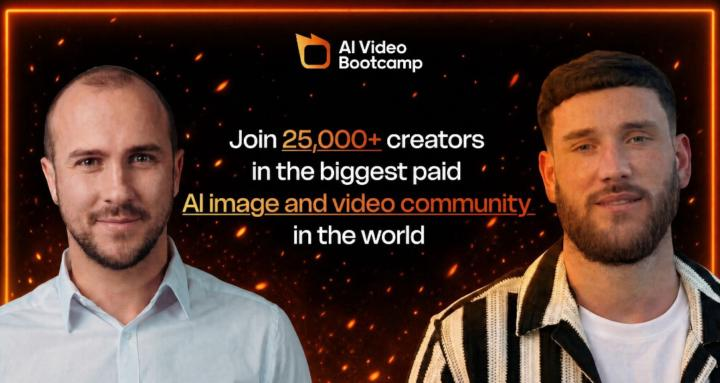
What is AI Video Bootcamp?
AI Video Bootcamp is a paid Skool community and video course run by Daniel Riley. It sits at the intersection of two things that are usually sold separately: a structured curriculum that teaches AI image and AI video creation from first principles, and a large, unusually active peer community where members post their work daily and get it torn apart, praised and improved. The stated promise on the welcome post is direct — help beginners, creators, filmmakers and entrepreneurs master AI and make their first $1,000 online.
The membership is built around three surfaces. The Classroom holds the nine-phase curriculum, unlocked in full the moment you join. The Community feed is where the day-to-day activity happens, split into categories: general discussion, competitions, wins, feedback, tools and resources, gems, homework and an opportunity hub. And the gamified level system layers XP, titles and rewards on top of both, so that contributing is worth something beyond karma.
What makes it distinct from the typical "AI course" is that it does not teach a single tool. Anyone who has bought a Midjourney course, a Runway course or a Sora course knows the problem: the model updates, the interface changes, and half the lessons become archaeology within three months. AI Video Bootcamp teaches the underlying craft — prompt architecture, composition, lighting, camera language, scene continuity — and then shows you which tool currently executes it best. That framing is the single biggest reason the material has held up as models have churned.
Inside the classroom: the full curriculum
The classroom opens with a "Start Here" track and runs through eight core modules before the live-call and monetization extras. It is designed to be taken in order, and the community is emphatic about this. Each module assumes the technical understanding built in the previous one, and skipping ahead to the filmmaking material without the foundations is the most common self-inflicted mistake new members make. Every module tracks your completion percentage, so progress is visible at a glance. Here is what each one covers.
🎯Start Here
Begin your journey: orientation, how the classroom is structured, and how to move through it in order.
1AI Creator Foundations
Learn the foundations of AI creation — prompt structure, the subject/environment/camera/lighting/mood/style framework, and how to think like a director rather than a typist.
2AI Images
Master AI image creation and editing: photoreal stills, composition, product shots and character consistency.
3AI Videos
Craft stunning AI videos — turning stills into motion, model selection, credit-efficient generation and fixing awkward shots.
4AI Advertising & UGC
Create scroll-stopping ads that convert: hooks, product scenes, AI influencers and the commercial work clients pay for.
5Advanced Flows
10x your output with node-based workflow systems — chaining tools, batching and building a repeatable pipeline.
6Social Media & Going Viral
Dominate social channels and reach virality: packaging output for short-form, pacing, captions and distribution.
7AI Filmmaking
Become a film-maker using AI — narrative shorts, scene continuity, sound design and editing it all together.
8Clone Yourself
Clone yourself and automate your content with avatars, voice and likeness cloning for talking-head and spokesperson video.
💸Live Calls + Monetization Extras
A few more ways to monetize with AI — live calls and bonus material layered on top of the core track.
AI Creator Foundations is where most of the leverage sits. The prompt framework taught there — subject, environment, camera, lighting, mood, style — turns prompting from guesswork into something closer to a shot list. You can see the effect in the homework threads: members who have internalised it write prompts that specify an eye-level candid iPhone shot on a weathered concrete ledge at midday with harsh directional sunlight, rather than "sunglasses, realistic, 8k". The outputs are not marginally better; they are in a different category.
AI Advertising & UGC and Advanced Flows are the modules that most directly connect to money. UGC-style ads, product visuals and AI influencer content are what small brands are currently buying, and the node-based workflow material teaches you to produce them repeatably rather than by accident. Clone Yourself is the newest frontier of the curriculum and covers avatars and voice — useful if you want to run a faceless channel or spokesperson-led ads without a camera. The Live Calls + Monetization Extras track then adds the business side: more ways to actually get paid for the output.
The community is the actual product
Plenty of communities are dead the week after launch. This one is not. Scroll the feed and the timestamps read "new comment just now", "2m ago", "7m ago" on post after post, across a membership that has passed 25,000 people. A popular competition thread will carry two or three thousand comments. That density is the difference between posting a question into a void and getting three answers before you have made coffee.
The homework categories are what make that activity useful rather than noisy. Members post Phase 2, Phase 3, Phase 4 and Phase 9 assignments with the prompt they used and the result, and ask specifically what to fix. You see people asking whether their avatar matches the source photo on a scale of one to ten, or flagging that a pterosaur's wing motion looks wrong but generation credits are expensive. The replies are practical. There is even active internal policing of low-effort feedback — one popular post called out members copy-pasting the same generic compliment and asked for real critique instead. A community that self-corrects on feedback quality is a healthy one.
The competitions deserve their own mention because they are the engine of that activity. Seven-day product image challenges with a $700 prize pool split between ten winners, weekly image challenges with $30 plus free lifetime access, colour-clash challenges — the briefs are deliberately open, so you get to see fifty different interpretations of the same Crocs or Rubik's Cube reference image. As a learning device this is quietly brilliant: you produce work under a deadline, then immediately compare your approach to hundreds of others. It also builds a portfolio faster than any lesson does.
The XP system reinforces it. Likes, comments, engaged posts and completed lessons all earn points, and titles escalate from Initiate through Apprentice, Creator, Architect, AI Wizard, Elite Member and Mentor to Grandmaster — which grants free lifetime access — and finally The Oracle, which pays $100 cash. The locked modules you see in the classroom are these titles, not withheld lessons; all course content unlocks at purchase. Worth knowing, because new members regularly mistake them for a paywall.
Quality of the output members are producing
The fairest way to judge a creative course is to look at what students ship. In the feed you will find a 75-second narrative short built entirely from yarn-and-linen textures, where characters visibly fray instead of ageing; a finished AI short film cut in Seedance with an original Suno score; a full UGC sunglasses ad with scripted voiceover, cinematic B-roll and lip-sync; a luxury watch commercial; a series of recreated Neverending Story scenes. These are not template outputs. They are people making creative decisions and using AI to execute them.
You will also find plenty of rough first attempts, which is arguably more useful. Phase 2 homework from complete beginners sits next to advanced work in the same feed, and the gap between them is a visible, achievable-looking ladder rather than an intimidating gulf. If you want evidence that the curriculum moves people along, that side-by-side is it.
Pros and cons
What we liked
- Structured, ordered curriculum instead of a folder of random tutorials
- Genuinely active feed — new posts and feedback within minutes
- Regular cash competitions with real prize pools and lifetime-access rewards
- Homework threads per phase, so you get critique on your actual output
- Gamified levels that reward helping others rather than lurking
- Tool-agnostic teaching that survives model releases
What to know first
- Tool subscriptions and generation credits are an extra cost on top
- The feed moves fast, so quieter questions can get buried
- Heavy promotion of the team's own tool, Promptwise
- Community-led feedback varies in depth depending who replies
- Income claims like 'your first $1,000' depend entirely on your own effort
The cost point matters most. Membership buys you teaching and community, not generation credits. Image and video models charge per render, and members openly discuss watching credits burn — one noted 135 credits per generation on a shot they were not even happy with. Budget for tool subscriptions alongside the membership, and treat the workflow lessons on cost-efficient generation as required rather than optional reading.
The Promptwise promotion is worth flagging for transparency. The team behind the bootcamp launched their own AI tool, built partly on community feedback, and it is actively promoted inside the feed. Members report good results with it, particularly on character consistency, and pricing is positioned below comparable tools. It is still a first-party product being marketed to a captive audience, so evaluate it on its merits rather than because it appears in the community you just joined.
Who AI Video Bootcamp is for
This is a strong fit if you are a complete beginner who wants an ordered path rather than a YouTube rabbit hole; a freelancer or marketer who wants to add AI ad creative and UGC to what you already sell; a small business owner producing your own product visuals; or an existing creator who can already make nice images but cannot yet turn them into consistent, finished video.
It is a weaker fit if you are already a professional AI video operator with your own pipeline — the advanced phases will still hold value, but the foundations will not. It is also a poor fit if you want passive income with no production work. The people posting wins are the people posting homework, entering every competition and giving feedback daily. The community rewards that pattern explicitly, and it does not reward lurking.
Verdict: is AI Video Bootcamp worth it?
Yes, with the usual caveat that a course cannot do the work for you. What you are buying is a curriculum that teaches transferable craft instead of a single tool, and access to a community large and active enough that your specific question about your specific broken shot will get answered the same day. The competitions turn practice into a habit and hand you a portfolio as a side effect. The teaching is clear, the ordering is deliberate, and the material tracks current models rather than last year's.
We hold back a sliver for the extra tool spend nobody warns you about loudly enough, and for the first-party tool promotion inside the feed. Neither is disqualifying, and both are common across this category. If you will actually watch the modules in order, publish homework and enter the challenges, this is one of the better-value AI creative memberships available right now. If you plan to buy it and then not open it, no review can help you — and that is true of every course ever sold.
Our recommendation: join, block out the first fortnight for Start Here through AI Videos, post every piece of homework publicly even when it is bad, and enter the next competition regardless of whether you think you can win. Members who do those four things are visibly further along three months later than members who do not.